
Electricity & Bills
How Much Does It Cost to Run an Appliance?
Watts to kWh to dollars: the one formula behind every appliance's running cost, with worked examples.
4 min read
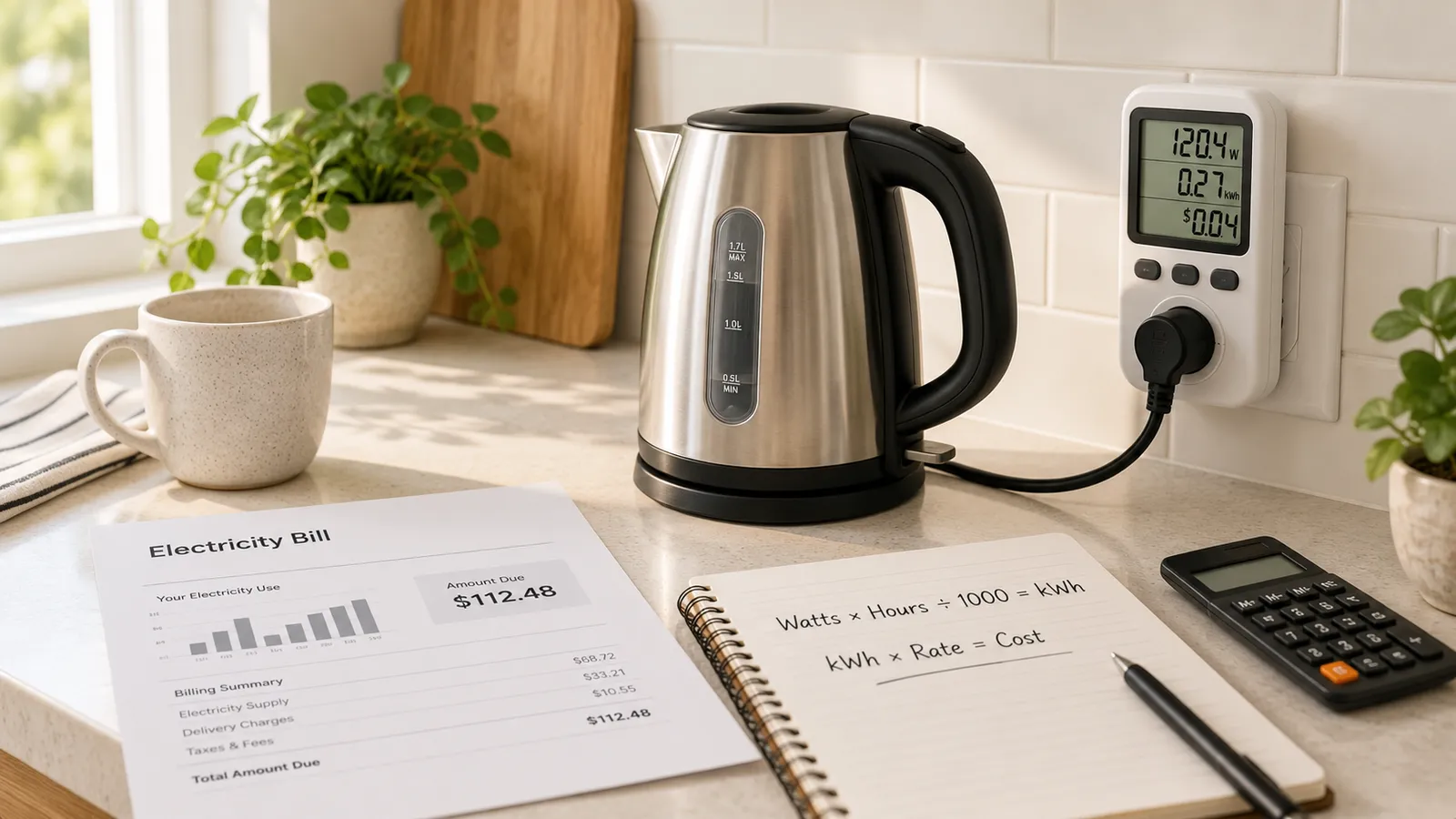
A 100-watt appliance running for 10 hours uses 1 kilowatt-hour (kWh). At an illustrative electricity rate of $0.18 per kWh, that costs 18 cents. Change the wattage, the hours, or the rate and the answer changes accordingly. The basic calculation is straightforward; figuring out which power number to use takes a little more care.
The formula behind the cost
Electricity cost = (watts ÷ 1,000) × operating hours × price per kWh.
Watts describe the rate at which a device uses electricity. A kilowatt is 1,000 watts. A kilowatt-hour measures energy consumed over time, and it is the quantity most electric utilities bill for. The distinction matters: a device rated at 1,500 watts doesn't necessarily use 1,500 kWh. At its full rated power, it uses 1.5 kWh per hour.
Take a 60-watt desk lamp used for five hours daily:
- Daily energy: 60 ÷ 1,000 × 5 = 0.30 kWh.
- Daily energy charge at $0.18/kWh: 0.30 × $0.18 = $0.054.
- Thirty-day energy charge: $0.054 × 30 = $1.62.
These amounts represent the energy component of the bill, not necessarily every fixed charge, tax, or adjustment on it.
What different appliances might cost
The following table deliberately uses hypothetical average power while operating, a rate of $0.18/kWh and a 30-day month. It is a calculation illustration—not a set of measured appliance benchmarks.
| Example device | Assumed average power | Use | Estimated 30-day energy cost |
|---|---|---|---|
| Desk lamp | 10 W | 5 hours/day | $0.27 |
| Television | 100 W | 4 hours/day | $2.16 |
| Desktop computer | 250 W | 4 hours/day | $5.40 |
| Space heater | 1,500 W | 4 hours/day | $32.40 |
| Always-on network device | 12 W | 24 hours/day | $1.56 |
The lesson isn't that one device type always uses the power shown. It is that watts multiplied by time drives consumption. A small 12-watt device left on all month can consume more energy than a powerful appliance used briefly.
Find the right wattage before calculating
Check the manufacturer's specification, equipment label or product documentation. If the label lists volts and amps, multiplying them gives an electrical power estimate for certain simple loads, but it is not always equal to true wattage on AC equipment because of power factor and how the device operates. Prefer a stated watt rating or an actual measurement.
A plug-in electricity monitor or compatible smart plug can measure energy used over several hours or days. This is especially helpful for refrigerators, computers and devices with standby modes. If you measure kWh directly, skip the watts-to-kWh step: multiply measured kWh by your electricity rate.
A refrigerator's compressor cycles on and off. A computer changes its power draw depending on activity. A washer uses different amounts of electricity during filling, agitation and spinning. For these products, one nameplate wattage multiplied by 24 hours often exaggerates the result.
Hourly, daily, monthly and yearly costs
Use the same formula but match the time period to the question. For a 1,000-watt appliance at $0.18/kWh:
| Actual operating time | Energy | Energy charge |
|---|---|---|
| 1 hour | 1 kWh | $0.18 |
| 3 hours | 3 kWh | $0.54 |
| 3 hours/day for 30 days | 90 kWh | $16.20 |
| 3 hours/day for 365 days | 1,095 kWh | $197.10 |
These scenarios assume the appliance continuously draws 1,000 watts during the listed hours. A thermostat, variable-speed motor or operating cycle may reduce actual energy use.
Which electricity rate should you enter?
Find the energy rate on your bill, usually expressed as dollars or cents per kWh. In some areas there are separate supply and delivery charges, seasonal tariffs, time-of-use prices, minimum bills or tiered rates. For a rough estimate, a blended variable rate can help; for a marginal calculation (the cost of adding one more kWh), use the charges that actually increase with usage. Dividing your entire bill, including fixed monthly fees, by kWh consumed does not always yield the correct marginal rate.
About the examples: Dollar amounts in this guide use explicitly stated sample rates, not a claim about your local utility's current price. Electric rates, taxes, fees, and usage patterns differ. For context, the U.S. Energy Information Administration reports a residential average revenue of 18.19 cents per kWh for January–August 2026; that national aggregate is not a substitute for your bill's marginal rate. EIA, Electric Power Monthly.
Three mistakes that change the answer
Confusing watts with kilowatt-hours. Watts indicate instantaneous power; kWh is the energy the meter records. Assuming full power all day. Many devices cycle or throttle. Ignoring how much use varies. A game console used for two hours on weekends has a different cost from one running all day.
If you need a personalized estimate, use the Electricity Cost Calculator with your device's power, realistic operating hours and your utility rate. To explore a different type of load, see how much electricity a refrigerator uses or how much a space heater costs to run.
The most reliable number is not always printed on the box. If your appliance varies its power, measure kWh over a representative period and calculate from that result.
Sources and further reading
More on electricity & bills
Electricity & Bills
Why Is My Electric Bill So High?
A step-by-step way to find what's really driving your bill, from heating and cooling to always-on devices.
3 min read