
Heating & Natural Gas
How Much Does It Cost to Run a Space Heater?
What a 1,500-watt heater really costs per hour, day and winter — and how the thermostat changes the math.
3 min read
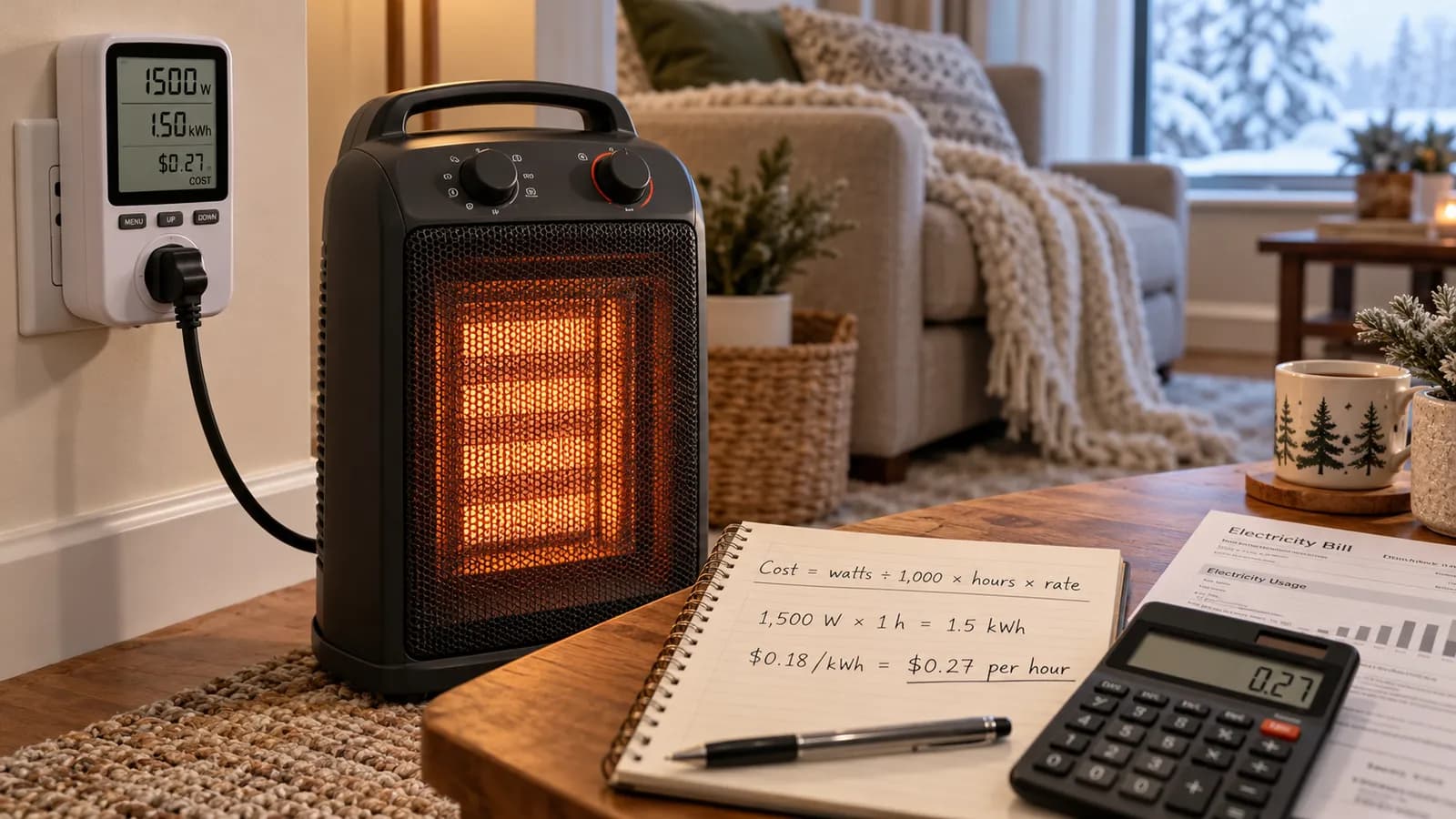
A 1,500-watt electric space heater drawing full power costs $0.27 per hour at an example electricity rate of $0.18/kWh. Run it at full power for eight hours and the energy charge is $2.16; repeat that daily for 30 days and it reaches $64.80. But those numbers assume continuous full-power operation. A thermostat can make actual consumption lower, depending on the room and outdoor conditions.
The simple space heater formula
Cost = heater watts ÷ 1,000 × hours drawing that power × electricity rate.
A 1,500-watt heater draws 1.5 kilowatts at its rated setting. One hour of full-power operation consumes 1.5 kWh, not 1,500 kWh. At $0.18/kWh, the calculation is 1.5 × $0.18 = $0.27 per full-power hour.
| Full-power operation | Electricity used | Cost at $0.18/kWh |
|---|---|---|
| 1 hour | 1.5 kWh | $0.27 |
| 4 hours | 6 kWh | $1.08 |
| 8 hours | 12 kWh | $2.16 |
| 8 hours/day for 30 days | 360 kWh | $64.80 |
| 8 hours/day for 90 days | 1,080 kWh | $194.40 |
This is an energy-only estimate. Your bill can also include fixed and other variable charges.
Thermostats change hours at full power, not the arithmetic
Many heaters switch their heating element on and off to maintain a set temperature. If a 1,500-watt heater is plugged in for eight hours but heats at full power for half that time, it consumes approximately 6 kWh, or $1.08 at the example rate. Fan use and standby electricity may add a small amount.
For an adjustable-power model, a lower heat setting can reduce the rate of energy use. But a heater on a low setting may run longer. The total energy required depends on room heat loss, insulation, temperature setting, outdoor weather and where the heat goes.
A thermostat isn't a universal 50% savings device. A drafty room may keep the heater on much longer than an insulated bedroom. If you need accuracy, measure consumption for several representative days with an appropriately rated energy monitor rather than assuming a fixed duty cycle.
How much does a space heater add to a winter bill?
Compare additional kWh with your existing bill. If your heater consumes 240 kWh over a cold month and your marginal electricity rate is $0.18/kWh, the incremental energy cost is $43.20. If your utility has tiered pricing or time-of-use rates, the actual increase may differ.
About the examples: Dollar amounts in this guide use explicitly stated sample rates, not a claim about your local utility's current price. Electric rates, taxes, fees, and usage patterns differ. For context, the U.S. Energy Information Administration reports a residential average revenue of 18.19 cents per kWh for January–August 2026; that national aggregate is not a substitute for your bill's marginal rate. EIA, Electric Power Monthly.
Is it cheaper than central heating?
Sometimes heating one occupied room while reducing heat elsewhere can save money. But simply adding a space heater while keeping the central thermostat unchanged often increases total consumption. Electric resistance heaters convert essentially all purchased electrical energy into heat inside the room; they do not multiply heat the way a heat pump can. A heat pump can deliver more heat per kWh of electricity because it moves heat rather than generating all of it with resistance.
A fair comparison considers the cost of the same useful amount of heat, not just the wattage label on two pieces of equipment. A gas furnace also has fuel-efficiency losses, and its blower uses electricity.
For a whole-house comparison, see how much it costs to heat a house, then explore the Home Heating Cost Calculator. To price an individual heater at your actual rate, use the Space Heater Running Cost Calculator.
Use a space heater safely
Place it on a stable surface and follow its manufacturer instructions. Keep combustible materials away, plug it directly into an appropriate wall outlet, and avoid extension cords or power strips unless explicitly permitted by the manufacturer. Do not leave portable heaters operating unattended or while sleeping unless the manufacturer's instructions specifically allow the intended use. Energy savings should never come at the expense of fire safety.
The most useful estimate is the monthly cost under your hours of active heating—not a dramatic annual figure assuming the heater runs continuously throughout winter.
Sources and further reading
More on heating & natural gas
Heating & Natural Gas
How Much Does It Cost to Heat a House?
Home size, climate, fuel and equipment efficiency — what actually sets your winter heating bill.
3 min read
Heating & Natural Gas
How to Calculate Your Natural Gas Bill
Therms, CCF and meter readings explained, with the fixed charges that set your bill's floor.
3 min read